Alberta’s oil and gas industry operates in conditions that are genuinely punishing for equipment and for the people maintaining it. Temperatures that drop below minus forty degrees Celsius in winter. Summer heat that pushes well above thirty. Wind that crosses open prairie with nothing to slow it down. UV radiation intense enough to degrade unprotected materials within a single season. Rain, snow, sleet, and freeze-thaw cycles that repeat for months.
The equipment that keeps production running in these conditions, pump jacks, engine housings, wellhead assemblies, compressors, and the pump houses that shelter critical infrastructure, is expensive, difficult to access in remote locations, and essential to keep operating. Downtime caused by weather-related equipment failure on a producing well site is not just an inconvenience. It is a direct production loss that compounds for every hour the equipment is offline.
Custom oil field covers are one of the most practical and cost-effective tools available for protecting that equipment investment. They extend the service life of machinery, reduce maintenance frequency, keep field staff protected during service calls in extreme weather, and prevent the kind of incremental weather damage that accumulates into expensive repairs over the life of a producing asset. This guide explains what oil field covers protect against, the main applications in the Alberta oilpatch, and what makes a cover worth the investment in a demanding industrial environment.
What Alberta’s Oilpatch Actually Does to Unprotected Equipment
The case for oil field covers starts with understanding the specific damage mechanisms that Alberta’s environment inflicts on oilfield equipment over time. Each of these mechanisms is preventable or significantly reducible with proper coverage.
Extreme Cold and Freeze-Thaw Cycling
Alberta winters are among the most severe operating environments for mechanical equipment in the world. At temperatures below minus twenty degrees Celsius, elastomers in seals and gaskets become brittle and lose their sealing effectiveness. Lubricants thicken and lose their flow characteristics, increasing wear on moving components at startup. Condensation that forms on warm equipment surfaces during temperature swings freezes into ice that expands in joints, around fasteners, and inside valve housings, gradually forcing components apart.
Engine covers that retain heat around critical mechanical systems reduce the temperature differential that equipment experiences through the overnight lows of an Alberta winter. Pump house enclosures maintain a controlled thermal environment around wellhead equipment and instrumentation that would otherwise be exposed to ambient conditions. The difference between equipment that starts reliably at minus thirty-five and equipment that requires extended warm-up periods or fails to start entirely often comes down to whether the thermal environment around that equipment has been managed.
Wind, Blowing Snow, and Precipitation
Open prairie oil field sites have essentially no wind break. Wind-driven snow infiltrates enclosures, accumulates against equipment, and when it melts, introduces moisture into electrical connections, instrument housings, and mechanical assemblies that are not designed for wet conditions. Ice buildup on moving components causes binding and increases mechanical load. Wind itself carries abrasive particulate that erodes surface coatings, accelerates corrosion on exposed metal, and degrades rubber and plastic components over time.
A properly fitted equipment cover or pump house enclosure eliminates direct wind and precipitation exposure, keeping the microenvironment around critical equipment significantly warmer, drier, and calmer than the site conditions outside. This single improvement in environmental conditions reduces maintenance frequency and extends the interval between service requirements substantially on equipment that would otherwise be fully exposed.
UV Radiation and Summer Heat
The UV and heat damage side of Alberta oilfield equipment exposure is less dramatic than winter cold but equally cumulative. Intense summer UV radiation degrades rubber seals, hydraulic hoses, insulation on electrical wiring, and protective coatings on metal surfaces at a rate that accelerates significantly on unprotected equipment. Equipment that spends several Alberta summers in direct UV exposure will show seal failures, cracked hose insulation, and paint degradation that covered equipment simply does not develop at the same rate.
UV-stabilized covers that block radiation from reaching sensitive components extend the service life of seals, hoses, and coatings in a way that is difficult to quantify precisely but is immediately apparent when you compare the condition of covered versus uncovered equipment after three to five years of field operation.
Corrosion and Surface Degradation
Moisture, salt from road spray on equipment transported to and from sites, and the chemical environment around producing wells all contribute to corrosion on unprotected metal surfaces. Corrosion that begins on surface coatings progresses to base metal, weakens structural components, and eventually compromises the integrity of equipment that needs to operate reliably under load in remote locations where repair access is not always immediate.
Covers that keep equipment dry and shielded from environmental contamination significantly slow the corrosion process. On equipment with service lives measured in decades, the cumulative impact of reduced corrosion rate on maintenance costs and equipment longevity is substantial.
Main Applications for Custom Oil Field Covers
Pump Jack Engine Covers
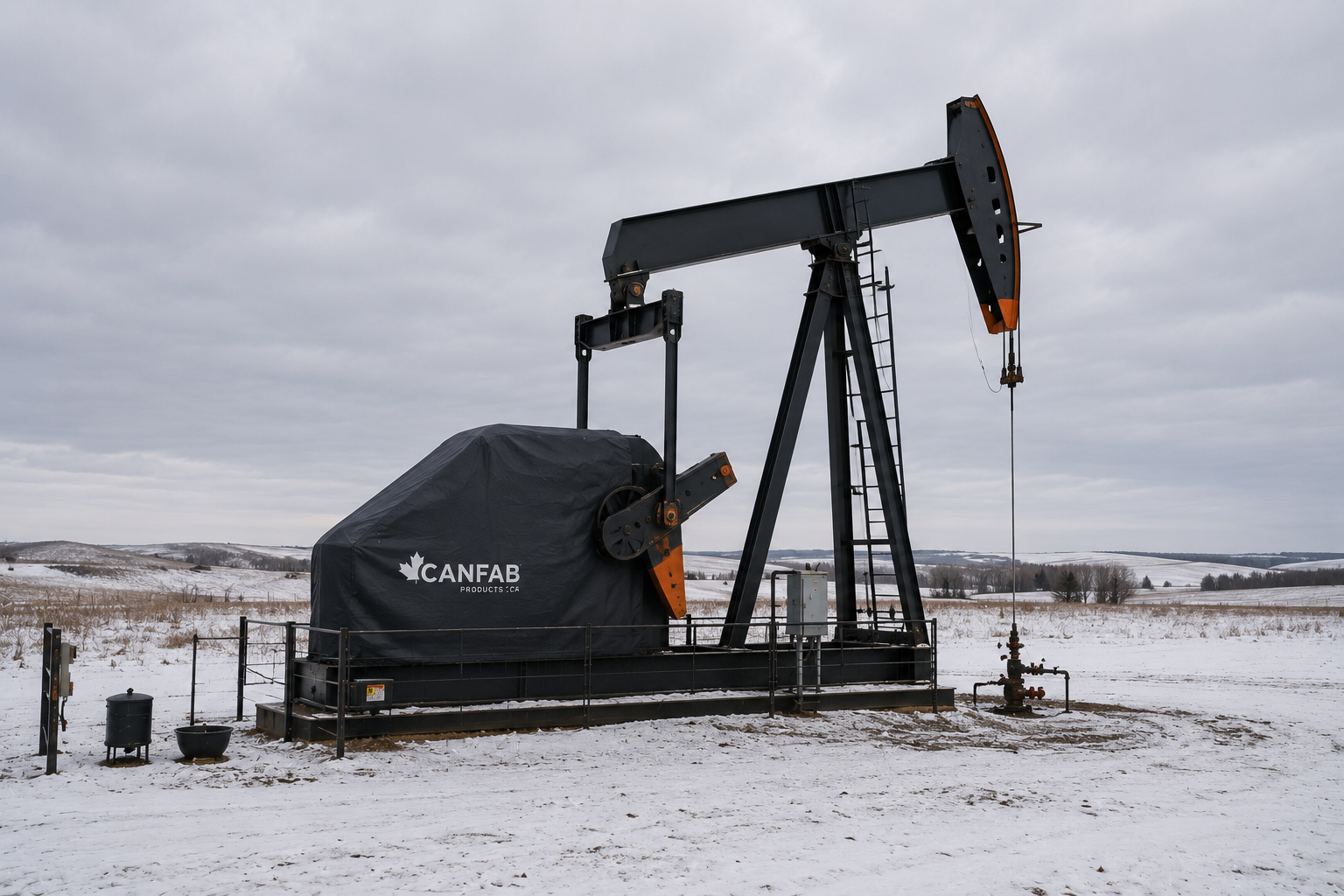
The engine unit that drives a pump jack is the most mechanically complex and maintenance-intensive component of a producing well site. It operates continuously in whatever conditions the Alberta weather provides, and maintaining it in proper operating condition requires regular access for service while also protecting it from the environmental factors that accelerate wear and component failure.
Custom engine covers for pump jack units are fabricated to fit the specific profile of the engine housing, with provisions for exhaust outlet clearance, service access panels, and ventilation openings that maintain appropriate operating temperatures while blocking direct exposure to wind, precipitation, and UV radiation. A well-fitted engine cover is not simply a tarp draped over the unit. It is a precisely shaped enclosure that accounts for the geometry of the specific engine model, stays in place under field wind conditions, and allows service personnel to access maintenance points without removing and replacing the entire cover on every visit.
Pump House Enclosures
Pump houses protect the wellhead assembly, surface safety valves, chemical injection equipment, and instrumentation that manage production at a well site. The level of environmental protection provided by a pump house directly affects the reliability of this equipment and the frequency of service interventions required to keep it operating within specification.
Custom fabricated pump house enclosures from Canfab Products are built to the specific dimensions and configuration of the equipment they house, with consideration for access requirements, ventilation needs, the weight of potential snow loads, and the wind exposure of the specific site location. These are not standard-size structures that are modified to fit. They are purpose-built enclosures designed for the equipment, the site, and the climate conditions of the Alberta oilpatch.
Pump house enclosures also provide the thermal environment needed to keep instrumentation, chemical injection lines, and control systems within their operating temperature ranges through Alberta winters. Chemical injection equipment that freezes is not just offline. It is potentially a safety concern that requires immediate intervention. A properly insulated and heated pump house enclosure eliminates freeze-related instrumentation and chemical handling failures entirely.
Wellhead and Christmas Tree Covers
Wellhead assemblies and the valve and fitting configurations that control production flow are exposed to the full range of Alberta weather conditions throughout the year. Individual wellhead covers that fit over the assembly protect valves, fittings, and instrumentation from direct precipitation and UV exposure while still allowing access for routine valve operation and inspection.
In winter, wellhead covers that retain some thermal mass around the assembly reduce the risk of valve freeze-up that can make routine operation difficult and in some cases unsafe. On remote sites where a frozen valve requires a service call to resolve, the cost of that call compared to the cost of a proper wellhead cover makes the economic case for coverage straightforward.
Compressor and Generator Covers
Field compressors and generators are high-value pieces of equipment that often sit idle between uses, particularly on battery sites and multi-well pad operations where they are cycled in and out of service based on production requirements. Equipment that sits idle without protection accumulates the same weather damage as continuously operating equipment without the benefit of the heat generated by operation to moderate the immediate thermal environment.
Custom compressor and generator covers fit the profile of the specific unit, account for exhaust and ventilation clearances, and provide protection during idle periods that significantly extends the service life of these assets. For rental compressors and generators that cycle between sites, a fitted cover also reduces the cleaning and preparation time required between deployments.
Staff Shelter and Work Area Covers
Field service personnel working on pump jack units, wellheads, and pump houses in Alberta winter conditions are exposed to the same severe weather that damages equipment. Wind chill at minus twenty-five with a thirty kilometre per hour wind makes extended outdoor work not just uncomfortable but a genuine cold stress hazard that limits how long a technician can work effectively before requiring shelter.
Custom work area covers and portable field shelters provide a protected environment that allows service work to continue safely in conditions that would otherwise require suspension of activity. A cover that can be quickly deployed around a work area, retaining body heat and blocking wind, extends the effective working window in cold conditions and reduces the safety risk for field personnel conducting maintenance on exposed equipment.
What Makes a Quality Oil Field Cover
The operating environment of the Alberta oilpatch makes material specification and fabrication quality more critical than in almost any other application. Here is what separates a cover that performs reliably through years of field use from one that fails within a season.
Material Specification for Extreme Temperature Range
Standard PVC and polyethylene materials become brittle at the low end of Alberta’s winter temperature range and can crack under impact or when flexed during deployment and retrieval. Materials specified for oilfield applications need to remain flexible and tear-resistant across the full temperature range the cover will be exposed to, from summer highs above thirty degrees to winter lows at or below minus forty. Low-temperature formulations of both PVC-coated polyester and polyethylene are available and should be specified for any cover that will be used or deployed in winter field conditions.
UV Stabilization for Year-Round Outdoor Exposure
Oil field covers are outdoors year-round in conditions of high UV intensity during the summer months. Materials without UV stabilization will chalk, crack, and lose tensile strength within two to three seasons of outdoor exposure in the Alberta environment. Quality oilfield covers use UV-stabilized materials that maintain their physical properties through multiple years of continuous outdoor use, providing the long service life needed to justify the investment in custom fabrication.
Fastening Systems That Perform in the Field
A cover that cannot be reliably deployed and secured by a field technician in cold conditions, potentially while wearing heavy gloves, is a cover that will not be used consistently. Fastening systems for oil field covers need to be operable in cold temperatures with gloved hands, resistant to ice formation that would lock closures in place, and robust enough to hold the cover securely against the wind loads experienced on open prairie sites. Canfab Products designs fastening systems into oil field covers based on the actual conditions of the field environment rather than defaulting to standard hardware that may not perform when temperatures are below minus twenty.
Custom Fit for the Specific Equipment
An oil field cover only provides the protection it is designed for if it actually fits the equipment it is covering. Gaps at edges, poorly fitted access panels, and excess material that pools water or catches wind all compromise the effectiveness of the cover and can create new problems, pooled water freezing against equipment surfaces, wind-driven movement abrading painted surfaces, access panels that are difficult to operate in the field.
Every cover Canfab Products fabricates for oilfield applications is built to the specific dimensions and configuration of the equipment it will protect. We work from measurements and, where possible, specifications of the specific equipment model to ensure the cover fits precisely, accounts for all access and clearance requirements, and provides the complete environmental protection the application requires.
Replacement and Repair Services
Oil field covers that have been in service for several years in Alberta conditions eventually reach the point where the material has degraded beyond repair or where damage from field operations requires replacement. Canfab Products provides replacement cover fabrication for existing installations where the mounting hardware or structural frame is still serviceable, allowing the protective function to be restored without the cost of replacing the entire system.
We also provide repair services for covers with localized damage that does not warrant full replacement. Field tears, damaged fastening points, and worn access panel hardware can often be repaired and reinforced to extend the service life of a cover that is otherwise in good condition. Our team can assess whether repair or replacement represents the better long-term value for a specific cover and provide honest guidance on which direction makes the most operational and economic sense.
How Canfab Products Can Help
Canfab Products Ltd. has been fabricating custom oil field covers for pump jacks, pump houses, wellheads, compressors, and field work areas across Alberta and Western Canada for over 30 years. We understand the specific demands of the Alberta oilpatch environment and we build our products to perform in those conditions across multiple seasons of continuous outdoor exposure.
Every cover we produce is fabricated to order at our Edmonton facility from materials specified for the application, with fastening systems and access provisions designed for real field use. Whether you need a single replacement cover for a specific pump jack unit, a set of covers for a multi-well pad, or a custom pump house enclosure for a new installation, our team will work with you to specify the right solution and deliver it on a timeline that works for your operation.
Final Thoughts
The Alberta oilpatch is one of the most demanding operating environments in the world for industrial equipment and for the people who maintain it. Custom oil field covers do not solve every challenge of operating in that environment, but they address a specific and significant category of preventable damage and downtime that compounds in cost over the life of a producing asset.
Equipment that is properly covered operates more reliably, requires less frequent maintenance intervention, and lasts longer than equivalent equipment left fully exposed to Alberta’s weather. Field staff who have access to covered work areas can work safely and effectively in conditions that would otherwise require activity suspension. These are real operational benefits with real economic value, and they are available from a straightforward investment in properly specified and fabricated custom covers.Contact Canfab Products Ltd. in Edmonton today to discuss your oil field cover requirements and request a free quote. Call us at 780-451-4341 or visit canfabproducts.ca.