Farming in Alberta is a year-round commitment, and so is protecting what makes the operation run. The equipment, feed, and supplies sitting on a farm property represent years of investment and every dollar lost to preventable weather damage, rust, or mold is a dollar that comes directly out of the operation’s margin.
Alberta’s climate does not give farm equipment and stored crops an easy time. Summers bring intense UV radiation, hail, and sudden violent thunderstorms. Winters arrive fast, stay long, and push temperatures that would damage unprotected machinery and compromise hay quality. Spring thaw creates moisture conditions that accelerate rust and mold if equipment and stored materials are not properly covered. Fall harvest windows are tight and the ability to protect what you have brought in matters enormously when the weather turns before you are ready for it.
Custom agriculture covers address all of these conditions in a way that generic tarps from a farm supply store simply cannot. This guide covers the main applications for custom farm covers on Alberta operations, what makes a cover worth the investment, and what to look for when you are ready to replace a cover that has stopped doing its job.
Hay Storage Covers: Protecting Your Feed Investment
Hay is one of the most significant variable costs in any livestock operation and one of the most vulnerable to weather damage. Round bales left uncovered or under poorly fitted tarps lose more than just surface material. Moisture penetrates the outer layers of the bale, creating conditions for mold to develop through the interior. A bale that looks intact from the outside can be largely unusable by the time feeding season arrives if it has been inadequately covered through a wet fall or a winter with significant snow and freeze-thaw cycling.
The nutritional losses from weather-damaged hay compound the economic impact. Moldy or weather-degraded hay has reduced digestibility and lower protein content, which means livestock need to consume more to maintain condition. In a tight feeding season, degraded hay can also create health risks for cattle and horses, adding veterinary costs to the direct loss of feed value.
What a Good Hay Cover Does
A properly fabricated hay tarp creates a weathertight seal over the bale or bale row that sheds water at the top, prevents moisture from wicking in at the sides, and stays anchored through wind events that would lift and displace a generic tarp. The material needs to be UV stabilized to resist the degradation that Alberta’s summer sun causes in un-treated polyethylene, and heavy enough to resist tearing when wind gets under the edges.
Custom sizing matters significantly for hay covers. A tarp that is sized for the actual diameter and length of your bale configuration, whether individual round bales, rows of round bales, or square bale stacks, provides complete coverage without the excess material that pools water, creates wind catch, and eventually tears. A tarp that is two feet short on one end because it was the closest standard size available is a tarp that lets water in at exactly the wrong spot all winter.
Row Covers vs. Individual Bale Tarps
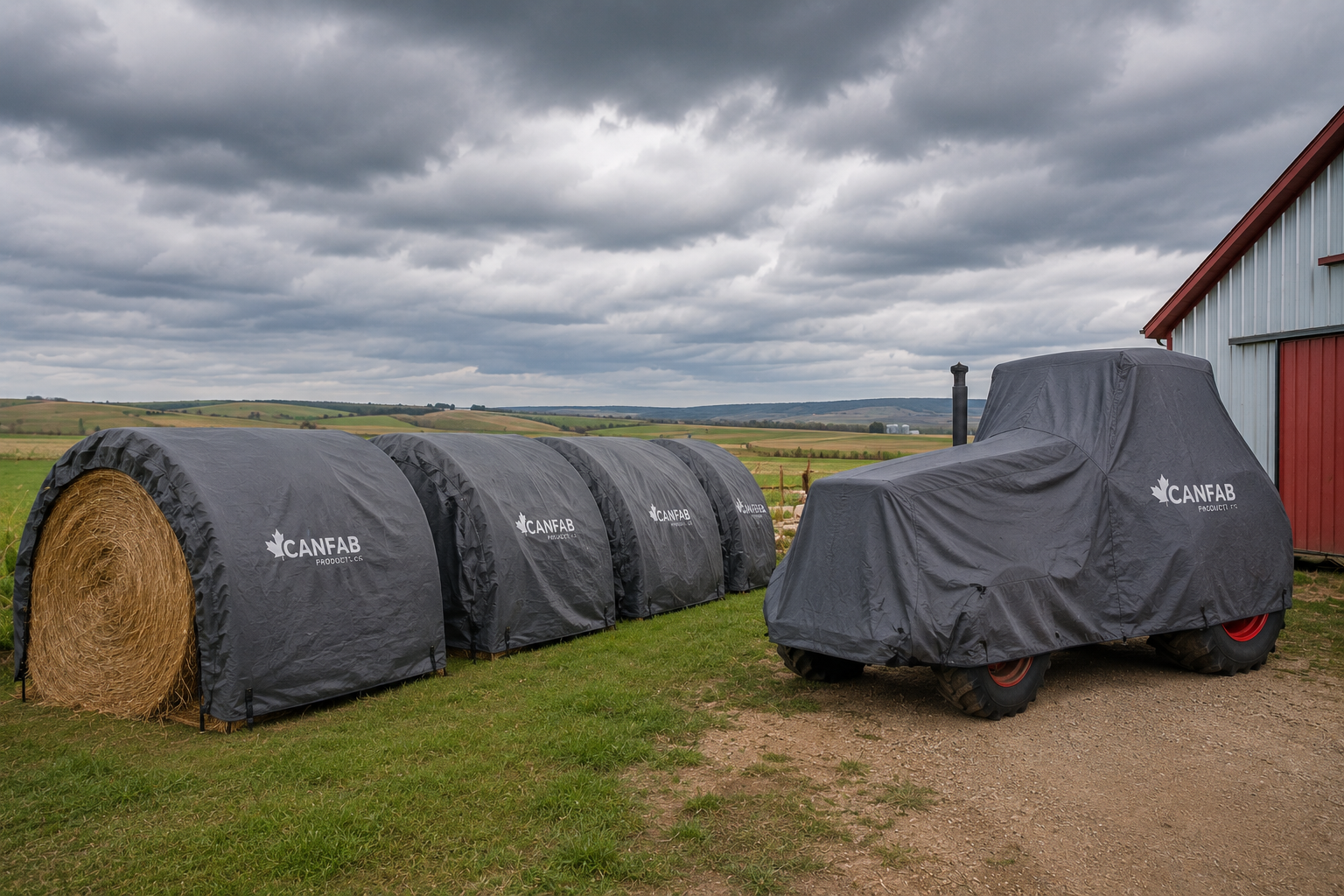
For operations storing large numbers of round bales, a continuous row cover that runs the full length of a bale row and anchors at ground level on both sides provides more complete coverage and is faster to deploy than individual bale tarps. Row covers are fabricated to the specific width and length of your bale configuration and can be designed with anchor sleeves, weighted edges, or strap and buckle systems that keep the cover firmly in place through wind events without requiring individual anchoring of each bale.
Individual bale covers are the better choice for operations where bales are moved frequently or stored in varying configurations, as they provide flexibility without requiring the whole cover to be moved when one bale is pulled. Canfab Products fabricates both styles in custom dimensions for the specific bale sizes and storage configurations of each client’s operation.
Equipment Covers: Protecting Your Machinery Investment
Farm equipment represents some of the largest capital expenditures in any agricultural operation. A combine, tractor, seeder, or sprayer that sits unprotected through an Alberta winter is accumulating damage that shows up in repair bills, reduced resale value, and shortened service life. Equipment covers are not a luxury for operations that care about asset protection. They are standard practice for anyone who has priced a replacement machine recently.
What Exposure Does to Farm Equipment
UV radiation degrades rubber seals, hydraulic hoses, belts, and cab materials faster than almost any other environmental factor. A tractor cab that spends five Alberta summers in direct sun will have faded, cracked, and deteriorated interior and exterior surfaces that a covered machine does not. Hail damage to sheet metal, cab glass, and exposed components is a direct and significant repair cost for uncovered equipment during Alberta’s hail season.
Moisture is the other major threat. Equipment left uncovered in fall and winter accumulates moisture in electrical connections, inside sealed housings, and on metal surfaces where paint has chipped or scratched. Rust forms at these points and spreads progressively, particularly on attachment points, frame members, and the undercarriage where accumulated moisture sits longest. Corrosion in electrical connectors causes intermittent faults that are expensive to diagnose and repair. A properly fitted equipment cover that sheds water and prevents moisture accumulation eliminates most of these conditions.
Custom Fit vs. Generic Equipment Covers
This is where the difference between a custom fabricated cover and a hardware store tarp is most obvious. Generic tarps are not shaped to fit farm equipment. They are draped over and tied down, which creates areas where water pools on flat surfaces, wind gets under loose sections and flaps against the machine, and the tarp contact points cause abrasion on painted surfaces over time. They also typically lack the UV stabilization needed to survive more than a season or two of Alberta sun without becoming brittle and tearing.
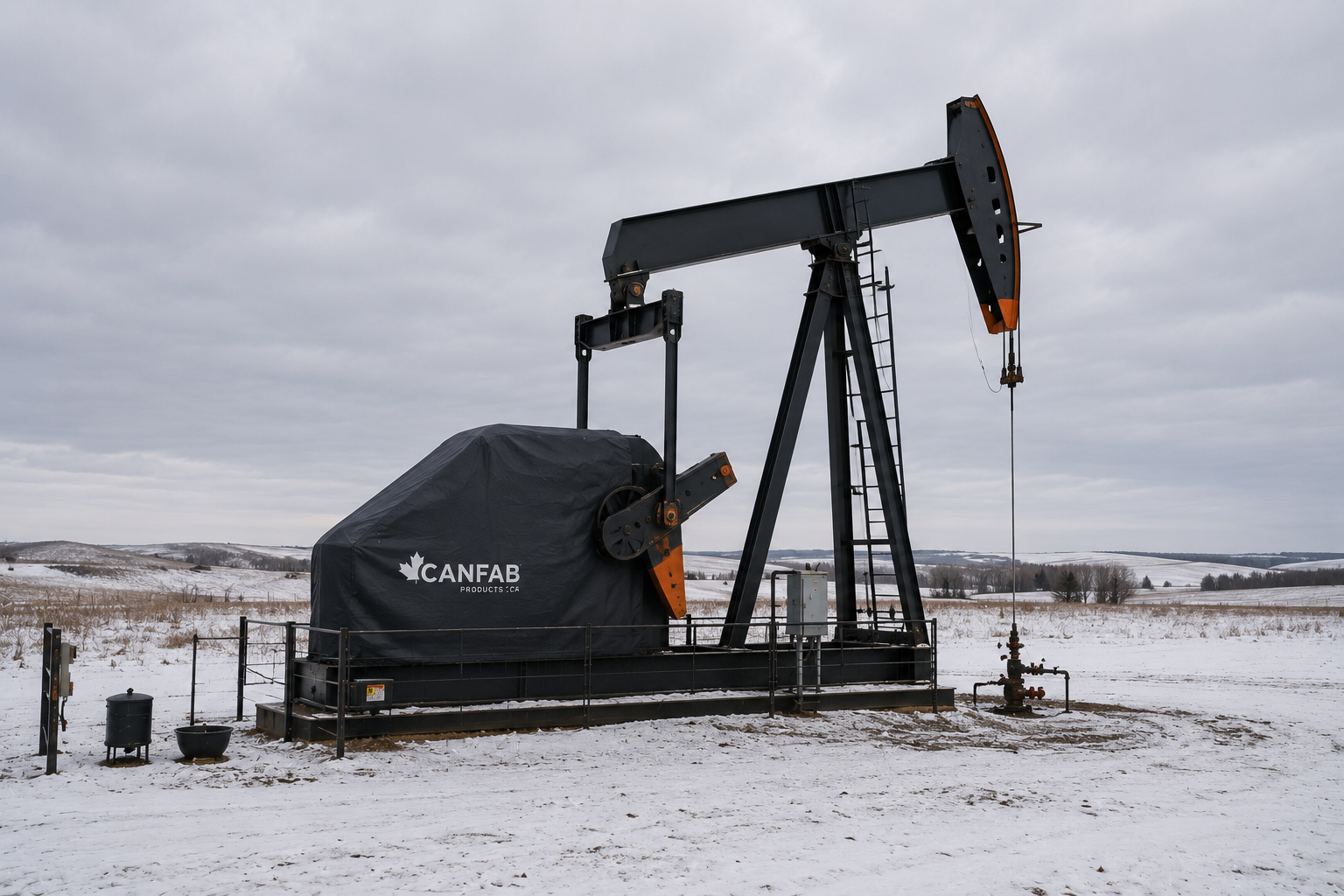
A custom equipment cover is patterned to the profile of the specific machine it is covering, with shaped sections for protruding components, reinforced openings for exhaust outlets and air intakes, and a fastening system that holds the cover snugly without requiring ropes tied over painted surfaces. It sheds water cleanly at the designed drainage points, does not flap in wind because it fits the machine rather than sitting loosely over it, and protects the surfaces beneath it without causing the abrasion that loose generic tarps create.
Common Equipment Applications
The range of farm equipment that benefits from custom covers is broad. The most common applications Canfab Products fabricates covers for include:
- Tractors of all sizes, from compact utility tractors to large row crop and 4WD machines, with shaped covers that fit the cab, hood, and rear axle configuration of the specific model
- Combines and swathers stored through the winter months, where the complex profile of the header, cab, and grain handling components requires custom patterning to provide complete coverage
- Seeding equipment including air seeders, disc drills, and planters, where the large footprint and irregular profile of the toolbar and tank assembly requires a custom-sized cover to provide meaningful protection
- Sprayers with tall tanks and boom configurations that make standard tarp coverage ineffective
- Tillage equipment including discs, cultivators, and plows that are stored outdoors between seasons and benefit from covers that keep moisture off metal ground engaging components
- Skid steers and loaders that work year-round but benefit from covers during extended idle periods
Outdoor Storage Covers: Protecting Seeds, Supplies, and Tools
Beyond hay and major equipment, most farm operations have a range of seeds, chemicals, tools, and supplies that are stored outdoors or in partially open structures where weather exposure is a factor. Custom covers for outdoor storage piles, seed bins, chemical storage areas, and tool staging zones protect these materials from the same UV, moisture, and freeze-thaw conditions that damage hay and equipment.
Seed quality is particularly sensitive to moisture exposure. Seed stored under a cover that allows condensation or allows water infiltration during rain events can lose germination viability before planting season, with direct consequences for yield. A properly sealed storage cover that prevents moisture from reaching the seed below is a straightforward protection against a loss that is entirely avoidable.
Chemical storage areas benefit from covers that prevent UV degradation of container labels and reduce the temperature cycling that can affect product integrity in plastic containers. Tools and smaller equipment stored outdoors or under open shed structures benefit from covers that shed water and prevent the rust formation that makes tools harder to use and reduces their service life.
What to Look for in a Quality Agriculture Cover
Not all farm tarps perform equally in Alberta’s conditions. Here are the factors that determine whether a cover will last and do its job through multiple seasons of real farm use.
Material Weight and Durability
Agriculture covers in Alberta need to handle a specific combination of stresses: intense summer UV, significant temperature swings, hail impact, wind load, and the abrasion that comes from being deployed and retrieved repeatedly across a working season. Lightweight polyethylene tarps that handle these conditions adequately on one or two uses typically degrade within a single season of regular use.
Quality agriculture covers are fabricated from heavy-gauge, UV-stabilized polyethylene or PVC-coated polyester in weights appropriate to the application. Hay covers and equipment covers that will be deployed for extended periods through winter conditions warrant heavier material than covers used for shorter-term seasonal storage. The right material specification depends on the specific use case and Canfab Products specifies materials based on the actual demands of each application rather than defaulting to the same weight for everything.
Reinforcement at Edges, Corners, and Anchor Points
The perimeter of a farm tarp is under constant stress from wind load, anchoring systems, and the physical handling of deployment and retrieval. A cover with an unreinforced hem will tear at the edge within a season of regular use in Alberta’s wind conditions. Quality covers have a heavily reinforced perimeter hem, corner patches that distribute anchor load across a larger area of material, and grommets or D-rings set in reinforced patches at regular intervals for secure anchoring.
For equipment covers with cutouts for exhaust outlets and other protruding components, reinforcement around these openings is equally important. Cutout edges that are not properly finished and reinforced will fray and tear from the movement of the cover in wind, eventually enlarging the opening to the point where the cover no longer provides meaningful protection at that location.
Anchoring Systems That Hold in Alberta Wind
Alberta produces significant wind events throughout the year and a cover that is not properly anchored is a cover that will be found in the next field after the first major wind event. The anchoring system needs to match the weight and profile of the cover and the wind exposure of the storage location. Options include weighted perimeter tubes or bags, bungee cord systems with ground anchors, strap and ratchet systems, and rope-and-grommet configurations.
For large hay row covers in exposed locations, a perimeter weighting system that runs continuously along the ground edge of the cover provides the most reliable wind resistance. For equipment covers, a combination of underbody straps and side cinches that pulls the cover snugly to the machine profile is generally more effective than perimeter anchoring alone because it eliminates the billowing that causes covers to fail at anchor points under sustained wind load.
How Canfab Products Can Help
Canfab Products Ltd. has been fabricating custom agriculture covers for farm operations across Alberta and Western Canada for over 30 years. We understand the specific demands of the Alberta climate and the practical realities of farm operations where covers need to deploy quickly, hold through unpredictable weather, and last across multiple seasons of real use.
Every cover we fabricate is built to order from our Edmonton facility to the exact dimensions and specifications of the application. Whether you need hay tarps sized to your specific bale configuration, custom equipment covers for your tractor and combine lineup, or storage covers for outdoor supplies and seed, we work with you to specify the right material, the right weight, and the right anchoring system for how your operation actually works.
We serve farm operations across Edmonton, Parkland County, and throughout Alberta and Western Canada. If your current covers are failing, undersized, or simply not holding up the way they should, contact us for a quote on custom replacements that are built for the conditions you are actually working in.
Final Thoughts
The investment in properly fabricated custom agriculture covers is straightforward to justify when you consider what it is protecting. Quality hay that represents months of growing and harvesting work. Equipment that costs hundreds of thousands of dollars to replace. Seeds and supplies that are needed at specific times in the growing season and cannot simply be reordered if damaged. Covers that fit properly, are made from appropriate materials, and are anchored correctly protect all of those assets through conditions that generic tarps cannot reliably handle.
Getting the right cover for each application on your operation means working with a fabricator who understands agriculture, understands Alberta’s climate, and builds products to last rather than to a price point that makes the next replacement sale inevitable.Contact Canfab Products Ltd. in Edmonton today to discuss your farm cover requirements and request a free quote. Call us at 780-451-4341 or visit canfabproducts.ca.