
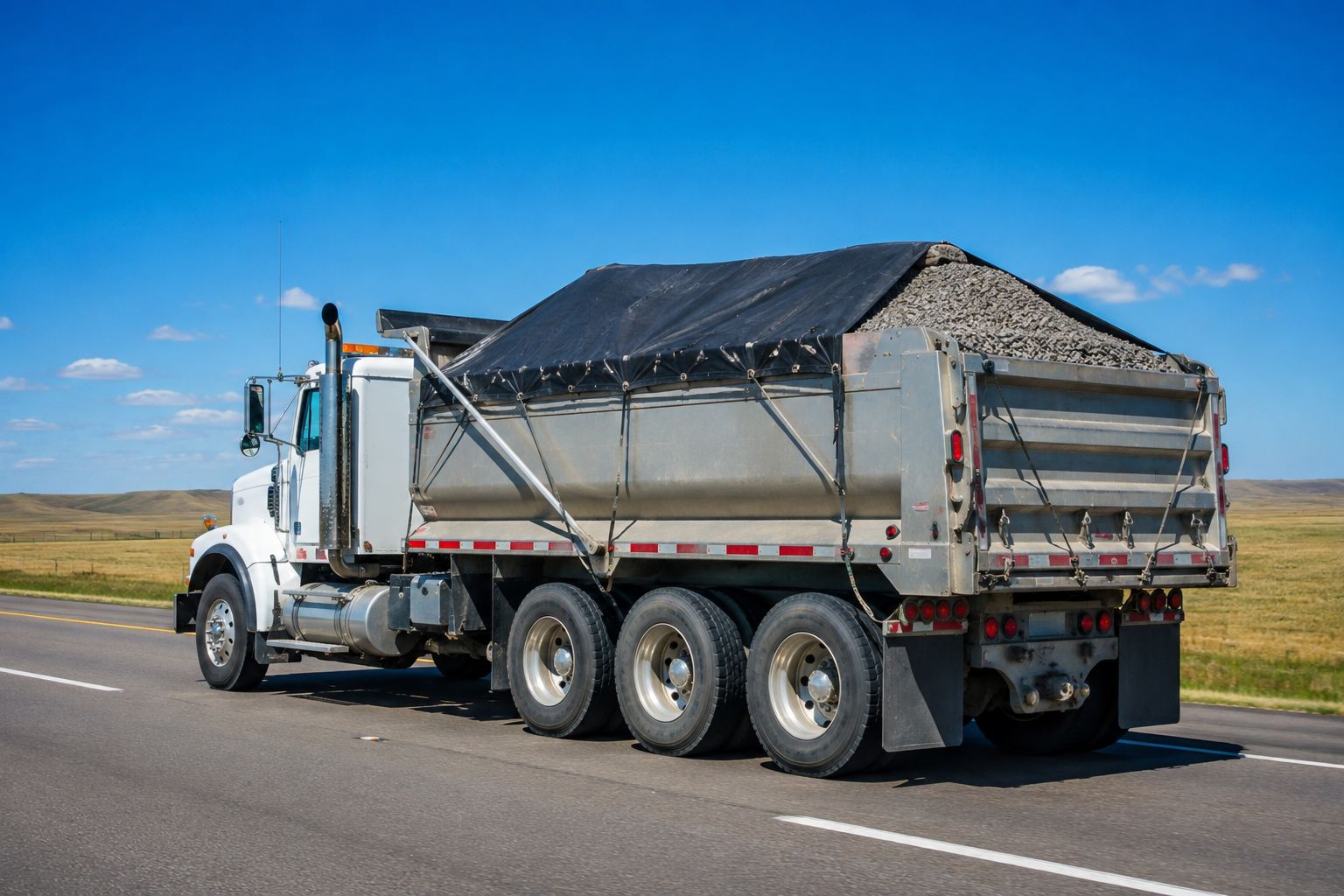
If you operate dump trucks in Alberta, whether you are hauling gravel, sand, demolition debris, topsoil, or aggregate on construction sites and public roads, load security is not optional. Unsecured or inadequately covered loads are a genuine safety hazard on the road, a source of liability exposure for your operation, and a compliance issue that can result in fines, vehicle detentions, and a damaged safety record.
Dump truck tarps are the standard solution for containing loose material during transit. But not all tarps are created equal, and the difference between a tarp that meets your legal and operational obligations and one that fails on the highway matters in ways that go well beyond the cost of the cover itself.
This guide covers what Alberta’s load security regulations require, what separates a reliable dump truck tarp from one that will cause problems, and how custom fabrication delivers a better fit and better performance than stock products for most commercial hauling operations.
What Alberta Law Requires for Load Security
In Alberta, the Transportation of Dangerous Goods Act and the Traffic Safety Act both impose obligations on commercial vehicle operators to ensure loads are properly secured and contained during transit. For dump trucks carrying loose material such as gravel, sand, soil, or demolition waste, covering the load is one of the primary means of meeting these obligations.
Under Alberta’s vehicle equipment regulations, any vehicle carrying a load that could shift, spill, leak, or blow off during transit must have that load properly secured or enclosed. For dump trucks, this means the box must be covered whenever the material being transported could reasonably become airborne or fall from the vehicle under normal driving conditions including braking, cornering, and highway speeds.
The practical standard that enforcement officers apply is straightforward: if your load could drop debris on the road or onto other vehicles, you are non-compliant. A gravel stone ejected from an uncovered dump truck at highway speed can cause serious damage to the windshield or bodywork of a following vehicle and can create liability for your company that far exceeds the cost of any tarp. Alberta Transportation enforcement officers conduct roadside inspections and can issue fines and detain vehicles found to be carrying unsecured loads.
Beyond provincial regulations, many municipal and private project sites across Alberta have their own specific requirements for covered loads as a condition of site access. Construction projects near urban areas, pipeline work sites, and aggregate operations frequently require that all outbound dump trucks be tarped before leaving the gate. Showing up to a job site with a tarp system that does not meet site requirements can result in delays and additional costs that affect your project timeline and your relationship with the client.
The Real Cost of a Tarp Failure
A dump truck tarp failure in transit is not just an inconvenience. The consequences can cascade quickly. A tarp that tears free or blows open at highway speed creates an immediate road hazard for vehicles behind the truck. Debris on the road surface causes accidents, and if your vehicle is identified as the source, your company’s liability exposure is direct and significant.
Beyond the safety and liability dimension, a tarp failure typically means stopping on the roadside to deal with a loose or missing cover, losing time on a haul cycle that affects your productivity for the rest of the day. If the failure results in material scattered on a public road, you may be responsible for cleanup. If it happens near an enforcement officer, you are looking at a fine and a potential inspection of your equipment records.
The cost of a properly fabricated, durable dump truck tarp is modest relative to any of these outcomes. Treating tarp quality as a place to save money is a false economy for any serious hauling operation.
Types of Dump Truck Tarps
Dump truck tarps come in several configurations, each suited to different hauling applications and operational requirements. Understanding the differences helps you choose the right product for how your trucks are actually used.
Aluminum Roll Tarps
Roll tarp systems use a mechanical roll-up mechanism mounted at the front of the dump box that allows the operator to deploy and retract the tarp from the cab or with a simple hand crank without climbing on the truck. The tarp rolls out over the full length of the box and fastens at the rear, covering the load completely when deployed and rolling up out of the way when the box needs to be loaded or dumped.
Roll tarp systems are the most convenient option for high-cycle operations where the truck is loading and dumping multiple times per day. The speed and ease of deployment means drivers are more likely to actually use the tarp consistently on every haul rather than skipping it when the cycle is busy. The roll mechanism also keeps the tarp protected and out of the way when not in use, which reduces the wear and UV degradation that affects tarps that are left exposed.
Roll tarp systems require proper installation on the truck box and the tarp itself needs to be fabricated to the exact dimensions of the box to seal properly at the sides and rear. A roll tarp that is too narrow or too short leaves gaps that defeat the purpose of the cover.
Side-Pull Tarps
Side-pull tarps, also called combo tarps or side-to-side tarps, are pulled manually across the top of the load from one side of the box to the other and fastened at the far side rail. They are simpler mechanically than roll systems and are a common choice for smaller operations or trucks that are used primarily for short hauls where the loading and dumping cycle is less frequent.
Side-pull tarps are typically fabricated from heavy PVC or polyethylene material with reinforced edges and multiple anchor points along the sides for fastening. The quality of the edge reinforcement and the fastening system is critical for this style of tarp, as the edges experience the most stress when the tarp is under wind load at highway speed.
Lumber and Flatdeck Tarps
For dump trucks that also carry lumber, steel, or other materials on a flatdeck configuration, a different tarp style is required. Lumber tarps are larger and heavier than standard dump tarps, covering not just the top of the load but also draping down the sides to provide full enclosure of the cargo. They are fabricated from heavier material and use a more extensive system of straps and buckles to secure the cover against the wind loads generated at highway speed with a tall, flat-sided load.
Canfab Products fabricates lumber and flatdeck tarps in custom sizes for the specific deck dimensions and load heights of each client’s equipment, ensuring a cover that fits the actual load profile rather than a generic size that is close but not correct.
What Makes a Quality Dump Truck Tarp
If you are evaluating dump truck tarps for your fleet, the following factors determine whether a tarp will hold up through a full work season of daily use on Alberta job sites and highways.
Material Weight and Tear Resistance
Dump truck tarps are subject to significant mechanical stress, the constant flexing and vibration of road travel at speed, contact with sharp aggregate material, exposure to UV radiation, and the regular abrasion of being rolled and unrolled or pulled across the box edges. Lighter weight tarp materials save cost upfront but fail faster under these conditions. For most dump truck applications in Alberta, a minimum of 18 ounce PVC coated polyester is the appropriate starting specification, with heavier material warranted for tarps carrying demolition debris or sharp aggregate that creates additional abrasion risk.
Reinforced Edges and Corners
The edges and corners of a dump truck tarp are where failure begins. A properly fabricated tarp has a heavy reinforced hem around the full perimeter, corner patches that distribute load across a larger area of material, and D-rings or grommets set in reinforced patches rather than directly in the base material. On roll tarp systems, the leading edge that attaches to the roll mechanism and the trailing edge that secures at the rear of the box both experience concentrated load and need to be fabricated accordingly.
UV Stabilization
Alberta’s summer sun is intense and UV degradation is one of the primary causes of premature tarp failure in outdoor working environments. A tarp that is not made from UV-stabilized material will become brittle and begin to crack and tear within a single season of regular outdoor use. Quality commercial dump truck tarps use UV-stabilized PVC or polyethylene materials that maintain their flexibility and tear resistance through multiple years of outdoor exposure. This is particularly important for tarps on roll systems where the material is repeatedly flexed through the rolling mechanism.
Custom Sizing for Your Box
This point is worth emphasizing because it is where the difference between custom fabrication and stock products is most apparent. A dump truck tarp only works if it actually covers the box it is meant to protect. Gaps at the sides where the tarp is too narrow, at the rear where it is too short, or along the front where the fit to the roll mechanism is imprecise are all pathways for material to escape the box during transit.
Dump truck boxes are not all the same size. Box lengths range from roughly twelve feet on smaller tandem axle trucks to eighteen feet and longer on larger units. Box widths vary between manufacturers and configurations. The height of the load above the box sides varies depending on the material being hauled and how full the box is. A tarp fabricated to the exact dimensions of your specific box and intended load height fits properly from day one and continues to provide complete coverage as it ages, rather than a stock product that was close enough when new but develops gaps as the material stretches or the fastening system wears.
Fleet Operations: Managing Tarps Across Multiple Trucks
For companies operating multiple dump trucks, tarp management becomes an operational consideration beyond just the individual cover. A fleet of trucks hauling on tight project timelines needs tarps that are consistent in quality, available when needed, and replaced before they fail rather than after.
Working with a fabricator who can supply consistent products to a defined specification across your fleet simplifies purchasing, ensures that all your trucks have equivalent coverage, and makes it straightforward to reorder replacements as existing tarps reach the end of their service life. Canfab Products works with fleet operators across Edmonton and Western Canada to supply dump truck tarps in the quantities and specifications needed for commercial hauling operations of all sizes.
We also fabricate replacement tarps for roll tarp systems, including cases where the original tarp has failed but the roll mechanism is still serviceable. Rather than replacing the entire system, a custom fabricated replacement tarp built to the exact dimensions of the existing mechanism restores full function at a fraction of the cost of a complete system replacement.
How Canfab Products Can Help
Canfab Products Ltd. has been fabricating custom tarps and transportation covers for commercial and industrial clients across Edmonton and Western Canada for over 30 years. We supply dump truck tarps to hauling companies, construction contractors, aggregate operations, and municipal fleet operators, and we understand the specific demands of Alberta’s hauling environment across all four seasons.
Every tarp we fabricate is built to order from our Edmonton facility to the exact dimensions of your box or deck configuration, using materials and hardware that are specified for the application. Whether you need a single replacement tarp for a specific truck, a set of matching tarps for a fleet, or a custom cover for a non-standard box configuration, we will work with you to get the specification right and deliver a product that performs reliably under real working conditions.
We also carry stock truck tarps in common sizes for operations that need a quick replacement while a custom order is being fabricated.
Final Thoughts
Dump truck tarps are a legal requirement, a safety obligation, and a practical necessity for any commercial hauling operation in Alberta. Getting them right means using tarps that are fabricated from the right materials, sized correctly for your boxes, and maintained in serviceable condition throughout the work season.
A tarp failure on the highway costs far more than the price of a quality cover, in time, liability, fines, and damage to your reputation with clients and project owners. The investment in properly fabricated dump truck tarps is one of the most straightforward risk management decisions a hauling operation can make.Contact Canfab Products Ltd. in Edmonton today to discuss your dump truck tarp requirements and request a free quote. Call us at 780-451-4341 or visit canfabproducts.ca.