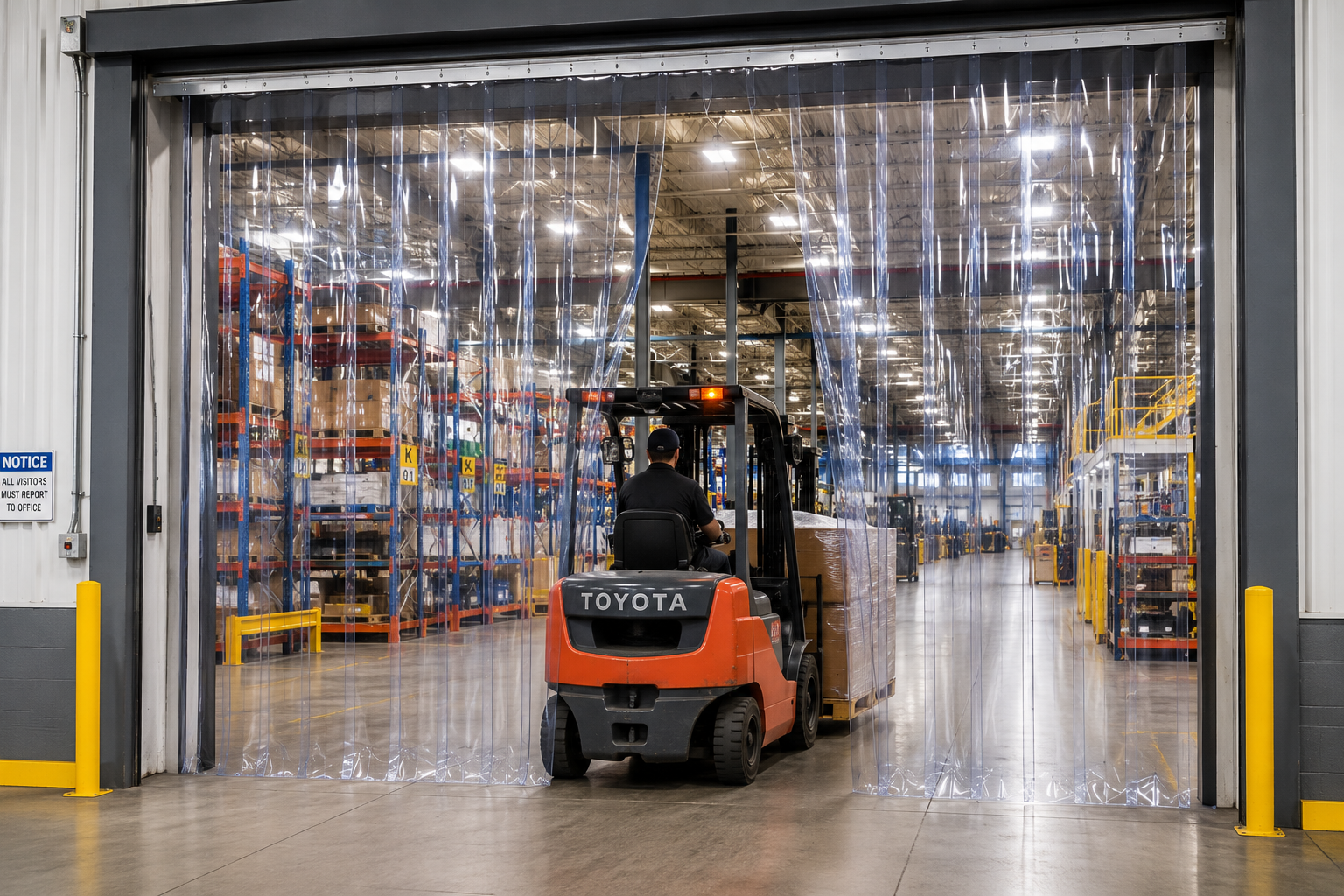
Walk through almost any busy warehouse, food processing plant, cold storage facility, or manufacturing floor and you will likely pass through a doorway fitted with overlapping strips of clear or tinted PVC hanging from floor to ceiling. You brush through them without thinking about it and they fall back into place behind you. They look simple, almost crude compared to the equipment around them. But those strip curtains are doing a significant amount of work.
PVC strip curtains are one of the most practical and cost-effective facility solutions available to industrial and commercial operators. They control temperature, reduce noise, separate work zones, limit dust and contaminant migration, and allow people, forklifts, and material handling equipment to pass through freely without the delay of operating a door. In cold storage environments, they can reduce energy consumption measurably. In manufacturing facilities, they make a real difference to noise levels and air quality in specific work zones.
Despite how familiar they look, there is more to specifying and installing a PVC strip curtain system correctly than most facility managers realize. This guide covers what strip curtains are, the environments they serve best, the different types available, and what determines whether a strip curtain installation actually delivers the results it is supposed to.
What Are PVC Strip Curtains?
PVC strip curtains, also called strip doors or vinyl strip curtains, are barrier systems made from overlapping vertical strips of flexible PVC material suspended from a mounting track or header above a doorway or opening. Each strip typically overlaps the adjacent strip by a third to a half of its width, creating a continuous barrier across the opening that provides meaningful thermal, acoustic, and contamination separation while allowing passage with minimal physical effort.
The strips part easily when a person, forklift, pallet jack, or cart pushes through and return to their overlapping position by gravity when the passage is complete. There is no door to open, no button to press, and no mechanism to maintain beyond keeping the strips clean and replacing individual strips when they become damaged or excessively scratched.
This simplicity is one of the primary reasons PVC strip curtains are so widely used in industrial and commercial environments. They require almost no maintenance, individual damaged strips can be replaced without taking the entire system down, and they continue functioning through the high-traffic conditions of a busy facility without the wear and mechanical failure that affect hinged and sliding door systems.
What PVC Strip Curtains Actually Do
Temperature Separation and Energy Conservation
This is the most quantifiable benefit of PVC strip curtains and the primary reason they are standard equipment in cold storage, food processing, and refrigerated distribution environments. Every time a conventional door opens between a temperature-controlled space and an uncontrolled area, conditioned air escapes and ambient air enters. In a busy facility where that opening happens dozens or hundreds of times per day, the cumulative energy cost is significant.
PVC strip curtains do not eliminate air exchange entirely but they reduce it dramatically compared to an open doorway. The overlapping strips create a barrier that limits the volume of air exchanged with each passage, and because the strips return to position immediately after passage rather than remaining open while an operator opens and closes a door, the total exposure time per passage is minimized. In cold storage applications, this translates directly to reduced compressor run time and lower refrigeration energy costs.
In Alberta’s climate, where the temperature differential between a heated warehouse interior and the outdoor environment can exceed fifty degrees Celsius in winter, strip curtains at loading dock openings and between heated and unheated zones also reduce heating costs meaningfully. A loading dock that operates without any door or barrier during active receiving periods loses an enormous amount of conditioned air. Strip curtains restore a significant portion of that separation without impeding the workflow of dock operations.
Dust, Debris, and Contaminant Control
In manufacturing, woodworking, metalworking, and food processing environments, controlling the migration of dust, debris, fumes, and airborne contaminants between work zones is both an air quality concern and a regulatory one. Open doorways between a sanding or grinding operation and an adjacent clean assembly area allow particulate to migrate freely with air movement. PVC strip curtains create a physical barrier that significantly limits this migration without requiring workers to operate a door every time they move between the zones.
In food processing and pharmaceutical environments, preventing cross-contamination between processing areas is a compliance requirement under Canadian food safety regulations and HACCP protocols. Strip curtains at zone boundaries between raw and ready-to-eat processing areas, between wash-down zones and dry storage, and at entry points from outside the facility are a standard part of contamination control programs in these industries.
Noise Reduction
Industrial environments generate significant noise from machinery, compressed air systems, material handling equipment, and manufacturing processes. PVC strip curtains provide meaningful attenuation of airborne noise transmission between zones, reducing the noise level experienced by workers in adjacent areas. While strip curtains do not provide the same isolation as a solid wall, they can reduce noise transmission by ten to fifteen decibels in typical applications, which is a noticeable improvement in working conditions in areas adjacent to high-noise operations.
Noise reduction through strip curtain separation also has a compliance dimension in Alberta workplaces. Occupational Health and Safety regulations set exposure limits for workplace noise and require employers to implement engineering controls to reduce noise exposure where levels exceed those limits. Strip curtains are a recognized engineering control that can contribute to noise reduction programs alongside hearing protection and administrative controls.
Traffic Separation and Safety
In facilities where pedestrian and forklift traffic share the same floor space, creating clear separation between pedestrian pathways and vehicle travel lanes improves safety. Strip curtains installed at the entry points to forklift operating areas create a visual and physical reminder for pedestrians that they are entering a zone where powered vehicles operate, without blocking visibility the way a solid door would.
The transparency of clear PVC strip curtains is a significant safety advantage over opaque barriers in high-traffic environments. A forklift operator approaching a strip curtain doorway can see through the strips to check for pedestrians or obstructions on the other side before passing through. This visibility through the barrier, which a solid door does not provide, reduces the risk of collision at intersection points and blind corners in busy facilities.
Types of PVC Strip Curtains
Standard Clear PVC Strips
Clear flat PVC strips are the most widely used type and the appropriate choice for most general warehouse, manufacturing, and commercial applications. They provide maximum visibility through the barrier, allow natural and artificial light to pass freely, and are available in a range of thicknesses and widths to suit different traffic volumes and opening sizes. Standard clear strips are the baseline option for temperature separation, dust control, and traffic management in environments where UV protection and specialized properties are not required.
Low Temperature PVC Strips
Standard PVC becomes stiff and brittle at low temperatures, which causes strips to crack rather than flex when pushed through in cold storage environments. Low temperature PVC strip curtains are formulated to remain flexible at temperatures as low as minus forty degrees Celsius, making them the correct specification for walk-in coolers, blast freezers, cold storage warehouses, and any application where the strip curtain operates in a sub-zero environment.
Using standard PVC strips in a cold storage application is a common and expensive mistake. The strips crack and split within a short period, creating gaps in the barrier that defeat the purpose of the installation and require frequent strip replacement. Specifying low temperature material for any below-freezing application eliminates this failure mode entirely.
Anti-Static PVC Strips
In environments where static electricity is a concern, such as electronics manufacturing, data centres, explosive storage areas, and certain chemical processing applications, anti-static PVC strips dissipate static charge rather than allowing it to build up as conventional PVC does. Anti-static strip curtains prevent the static discharge events that can damage sensitive electronics, ignite flammable vapours, or attract particulate contamination in clean room environments.
UV-Stabilized and Tinted PVC Strips
In applications where strip curtains are exposed to significant UV radiation, either from skylights, outdoor-facing openings, or high-intensity UV light sources within the facility, UV-stabilized PVC maintains its clarity and flexibility over time rather than yellowing and becoming brittle as standard PVC does under UV exposure. Tinted strips in amber, green, or blue tones are used in welding areas to provide UV and arc flash protection while maintaining visibility through the barrier, and in food processing areas where coloured strips provide clear visual zone demarcation.
Ribbed PVC Strips
Ribbed or textured PVC strips are used in high-traffic applications where forklift forks, pallet edges, and material handling equipment regularly contact the strips. The ribbed profile distributes impact stress across the thickness of the strip more effectively than flat strips, reducing the cracking and tearing that occurs at impact points under heavy traffic conditions. Ribbed strips typically have reduced optical clarity compared to flat strips but their durability advantage makes them the better specification for dock doors and high-cycle forklift passages.
Getting the Specification Right
The difference between a strip curtain installation that performs well for years and one that causes ongoing frustration comes down almost entirely to specification. The wrong material, the wrong strip width, inadequate overlap, or incorrect mounting hardware all produce installations that fail to deliver the separation they are supposed to provide.
Strip Width and Thickness
Strip width and thickness are selected based on the size of the opening and the type of traffic passing through. Narrow strips in the range of 150 to 200 millimetres wide are appropriate for pedestrian doorways with light traffic. Wider strips of 300 millimetres and above are standard for forklift passages and large doorways where the reduced number of strips lowers resistance to passage for wide equipment. Thickness is selected based on the application: lighter gauge material for pedestrian use, heavier gauge for forklift and equipment traffic.
Overlap
The overlap between adjacent strips is critical to the thermal and contamination separation performance of the curtain. Standard overlap is typically fifty percent of the strip width, meaning each strip covers half of the adjacent strip. Reducing overlap below this level to save material cost reduces the barrier effectiveness proportionally and is a false economy in any application where temperature or contamination control is the primary purpose of the installation.
Mounting System
The mounting track and hardware need to support the full weight of the strip curtain reliably at the specific ceiling height of the installation. Heavy strip curtains in wide doorways can be surprisingly heavy and the mounting system needs to be specified accordingly. The track position relative to the door frame also affects how well the curtain seals at the sides, and proper installation ensures that the outer strips overlap the door frame rather than leaving a gap at the edges.
How Canfab Products Can Help
At Canfab Products Ltd., we supply and install custom PVC strip curtains for warehouses, manufacturing facilities, cold storage operations, food processing plants, and commercial spaces across Edmonton and Western Canada. Every installation is specified to the exact dimensions of your opening and the specific demands of your application, whether that is standard clear strips for a warehouse passage, low temperature material for a cold storage doorway, or UV-tinted strips for a welding zone.
We have been working with industrial and commercial clients across Alberta for over 30 years and we understand the difference between a strip curtain specification that works in real facility conditions and one that looks adequate on paper but fails under the traffic and temperature demands of a working operation. Our team will assess your opening, understand your application requirements, and recommend the right material, width, thickness, overlap, and mounting system for your specific situation.
We also supply replacement strips for existing installations, including situations where the original strips have failed and the mounting hardware is still serviceable. Rather than replacing the entire system, replacement strips cut to your exact dimensions restore full barrier performance at a fraction of the cost of a complete reinstallation.
Final Thoughts
PVC strip curtains are a straightforward product that does a significant job in industrial and commercial facilities. Temperature separation, contamination control, noise reduction, and traffic safety are all real operational benefits that translate into lower energy costs, better working conditions, and improved compliance with workplace and food safety regulations.
Getting them right means specifying the correct material for the application, sizing the strips and overlap to match the traffic volume and opening dimensions, and mounting the system properly so that it seals effectively and holds up through the demands of a working facility. These are details that matter more than they appear to from the outside, and they are exactly the kind of detail that Canfab Products gets right on every installation.Contact Canfab Products Ltd. in Edmonton today to discuss your PVC strip curtain requirements and request a free quote. Call us at 780-451-4341 or visit canfabproducts.ca.