Construction sites in Alberta operate in some of the most demanding conditions in the country. Rain in the spring, intense UV and heat through the summer, early frosts, and full winter conditions that arrive fast and stay for months. Throughout all of it, work continues. Materials get delivered before they are ready to be installed. Partially built structures sit exposed overnight or through long weekends. Equipment sits idle during weather delays. Crews work in areas where dust, debris, and falling objects are constant hazards.
Tarps are one of the most practical and versatile tools on any job site, but not all tarps are created equal. The blue polyethylene tarps from a hardware store have their place, but on a serious construction site where materials are expensive, deadlines are tight, and safety matters, the difference between a generic off-the-shelf cover and a properly fabricated custom tarp is the difference between real protection and a false sense of security.
This guide breaks down the different ways custom tarps are used on construction sites, what to look for in a tarp for each application, and why getting the right cover for the job saves money and headaches over the course of a project.
Why Generic Tarps Fall Short on Construction Sites
Standard tarps sold at hardware and general supply stores are manufactured to common sizes with no consideration for the specific dimensions, loads, or conditions of your site. They come in limited weights, typically lighter gauge materials that are adequate for covering a backyard patio set but not built for the sustained stress of a working construction site.
The problems with generic tarps show up quickly in real conditions. Wind gets under loose edges and tears grommets out. UV exposure causes the material to become brittle and crack within a single season. Water pools in the centre of undersized covers and the weight causes tearing. The tarp is too short on one side and the gap lets water in at exactly the wrong spot. Grommets are spaced too far apart to anchor the cover properly against Alberta wind.
On a job site where lumber, insulation, drywall, windows, and roofing materials can represent tens of thousands of dollars in product, a tarp failure is not just an inconvenience. Wet lumber warps and can develop mold. Drywall that gets soaked is a write-off. Insulation that absorbs water loses its thermal performance. The cost of a tarp failure in damaged materials almost always exceeds the cost of doing it right the first time.
Custom fabricated tarps solve these problems by being built to your exact dimensions, from materials matched to your specific application, with hardware and reinforcement placed where the load will actually be applied.
Common Applications for Custom Tarps on Construction Sites
1. Covering Building Materials During Storage and Staging
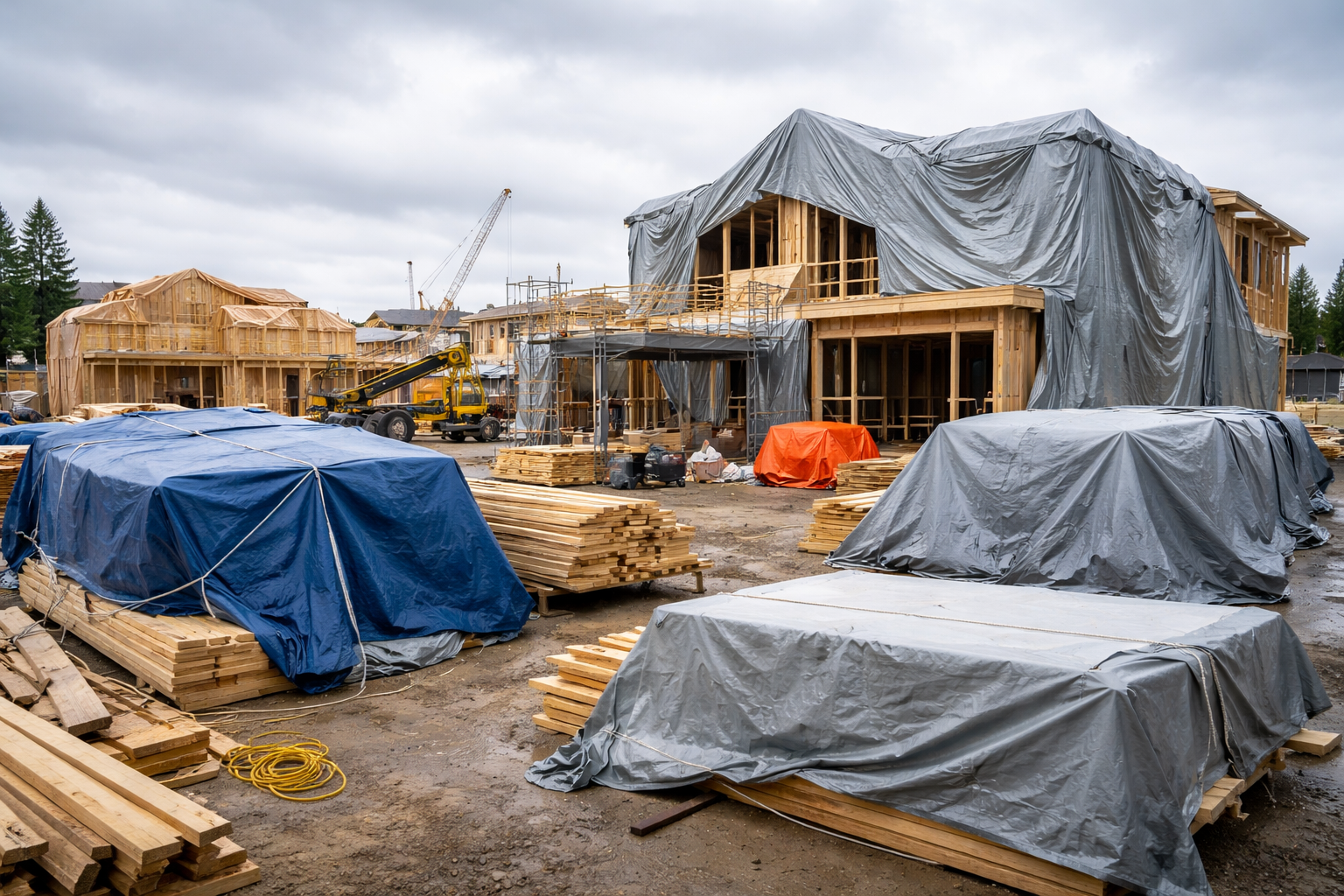
Every active construction site has a material staging area where deliveries accumulate before they are ready for installation. Lumber packages, roofing bundles, window and door units, insulation batts, and engineered wood products all need protection from rain, snow, and UV exposure from the moment they are delivered until the day they go in.
A custom tarp for material staging is sized to cover the full footprint of your staging area with enough overlap on all sides to stay anchored in wind and seal out water at the edges. Heavy reinforced grommets at close intervals allow the tarp to be secured tightly to lumber frames, stakes, or the material itself without tearing out under load. For materials that need to be accessed regularly throughout the day, a tarp with a weighted edge or a rope-and-grommet perimeter system allows fast deployment and retrieval without damaging the cover.
2. Weather Protection for Partially Built Structures
One of the most common and most critical uses for construction tarps is covering a structure that is in progress but not yet weathertight. A house that has been framed and sheathed but is waiting for roofing is completely exposed to whatever the weather brings. In Alberta, that can mean a significant rainfall event overnight or an early season snowfall that dumps wet snow onto open framing.
Covering a structure in progress requires a tarp that is large enough to drape over the peak and extend well past the eaves on all sides, heavy enough to resist wind without flapping and tearing, and fitted with enough anchor points to stay secured through a weather event. Canfab fabricates construction covers in custom sizes specifically for this application, including translucent options that allow natural light to continue entering the structure so that interior work can proceed even while the exterior is covered.
3. Hoarding and Debris Containment
On urban construction and renovation projects, containing dust, debris, and falling objects within the site boundary is both a safety requirement and a regulatory one. Hoarding systems use tarp panels secured to scaffolding or temporary framing to create a visual and physical barrier around the active work area. These panels need to be fabricated in consistent dimensions that match the framing system being used, with reinforced edges and connection points that allow individual panels to be attached and removed as the project progresses.
Dust containment during interior demolition and renovation is a related application. Heavy PVC tarp panels secured across doorways, stairwells, and open wall sections keep construction dust from migrating through occupied areas of a building during phased renovation work. These panels are typically custom fabricated to fit specific opening dimensions, often with weighted bottom edges to maintain a seal at the floor and zipper or velcro entry points that allow workers to pass through without disturbing the seal.
4. Equipment and Vehicle Protection
Construction equipment represents a significant capital investment and most of it spends a lot of time sitting on site between uses. Excavators, skid steers, generators, compressors, and material handling equipment all benefit from covers that protect against UV degradation of seals and hoses, moisture intrusion into electrical and hydraulic systems, and the general accumulation of debris that increases maintenance requirements over time.
Custom equipment covers are fabricated to fit the specific profile of each machine, with cutouts or panels for access hatches, exhaust outlets, and attachment points. A cover that fits properly stays in place in wind, does not pool water in areas that could cause damage, and can be deployed and removed quickly by a single operator. Generic blue tarps draped over equipment and tied with rope do none of these things consistently.
5. Ground Covers and Concrete Curing Blankets
Ground protection tarps are used to protect finished surfaces, control mud and tracked debris at site entrances, and protect vegetation and grade work in areas adjacent to active construction. These covers take foot traffic and equipment movement, so material weight and abrasion resistance matter significantly more than for overhead covers.
Concrete curing is another application that requires a specific type of cover. Freshly poured concrete needs to be kept moist and at a stable temperature during the curing period to achieve its design strength. In Alberta, where temperature swings during spring and fall can be dramatic and early frosts are a real risk, a proper curing blanket that insulates the slab while retaining moisture is essential. Canfab fabricates curing blankets in custom sizes with appropriate insulation value for Alberta’s climate conditions.
What Makes a Construction Tarp Worth the Investment?
If you are evaluating custom tarps for your construction operation, here are the specific qualities that determine whether a tarp will perform reliably through a full project season on an Alberta job site.
Material Weight and Weave Density
Tarp material is rated by weight in ounces per square yard. Lighter tarps in the range of five to eight ounces are appropriate for short-term dust and light weather protection. Midweight tarps from ten to fourteen ounces handle most general construction site applications including material covers and equipment protection. Heavy tarps from sixteen ounces and up are used for applications involving sustained wind load, abrasion, or equipment traffic. Using an undersized material for a demanding application is the most common reason construction tarps fail.
Reinforcement at Stress Points
The edges, corners, and grommet locations of a tarp are where failure almost always begins. A properly fabricated construction tarp has a reinforced hem around the full perimeter, corner patches that distribute load across a larger area, and grommets set in heavy reinforced patches rather than directly in the base material. On large covers, additional interior reinforcement strips running across the tarp provide attachment points in the middle of the cover where edge anchoring alone is not enough to prevent wind billowing.
UV and Chemical Resistance
Alberta’s summer sun is intense, and UV degradation is a real factor for tarps that spend months outdoors. Materials without UV inhibitors will become brittle and begin to crack and shed microplastic debris within a single season. Quality construction tarps use UV-stabilized PVC or polyethylene materials that maintain their flexibility and tear resistance through multiple seasons of outdoor exposure. On sites where tarps may come into contact with concrete, solvents, or other chemicals, material compatibility is an additional consideration.
Custom Sizing and Fit
A tarp that is the right size for the job is dramatically more effective than one that is close but not quite right. An extra foot of overhang on a material cover is the difference between water running off the edge and water wicking back under the tarp and into the stack. A cover that fits the dimensions of a framed structure keeps wind from getting underneath and lifting the cover off entirely. Custom fabrication to the exact dimensions of your application eliminates the compromises that come with standard sizes.
Custom vs. Off-the-Shelf: The Honest Comparison
Off-the-shelf tarps are cheaper upfront and available immediately from any supply store. For short-duration, low-stakes applications where a tarp will be used once and discarded, a standard product may be entirely appropriate. But for contractors and site managers who are using tarps as a regular, essential part of how they protect a job site, the economics shift quickly.
A custom fabricated tarp built from quality material for your specific application will outlast multiple cycles of cheaper replacements, perform more reliably in the conditions it was designed for, and reduce the risk of the tarp failures that lead to damaged materials and lost project time. Over the course of a full construction season, the total cost of ownership for a properly spec’d custom tarp is typically lower than the running cost of repeatedly replacing generic covers that fail under real conditions.
How Canfab Products Can Help
Canfab Products Ltd. has been fabricating custom tarps and covers for construction sites, industrial operations, and commercial applications across Edmonton and Western Canada for over 30 years. We understand the specific demands of Alberta job sites across all four seasons and we build our products to perform in those conditions, not just in a product specification sheet.
Whether you need a single custom cover for a specific piece of equipment, a set of hoarding panels for an urban renovation project, curing blankets for a concrete pour, or a standing supply of material covers for an ongoing construction operation, our team will work with you to specify the right material, the right weight, the right hardware, and the right dimensions for the job.
Every tarp we fabricate is built to order at our Edmonton facility. We do not stock generic sizes and call them custom. We measure, cut, weld, and finish each product to the specifications of the actual application it will be used in.
Final Thoughts
Tarps are not glamorous, but on a construction site they are doing real work every day. They protect materials that represent a significant portion of your project budget. They keep workers operating in conditions where they otherwise could not. They contain dust and debris that would otherwise create liability and regulatory problems. Getting them right means specifying the right material for the application, having them built to the right dimensions, and using hardware that will hold under real-world load.If you are managing an active construction site in Edmonton or anywhere across Western Canada and want covers that actually do the job, contact Canfab Products Ltd. today to discuss your requirements and get a free quote. Call us at 780-451-4341 or visit canfabproducts.ca.